
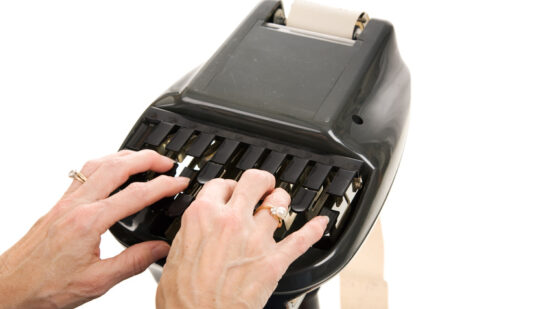

With concern over the high cost of legal services so acute that even the ABA is encouraging bars to consider allowing non-lawyers to provide limited scope services , it is unfathomable that the Hampden County Bar Association is opposing a move towards replacing court reporters with a digital reporting system, as reported in MassLive.com. The association claims that “This proposal [to eliminate 40 court reporters] however, risks the fair administration of justice, sacrifices important jobs, costs a lot up front, and only saves a little bit down the road.” But that’s a short-sighted view, focused only on the initial start-up costs of digital reporting while ignoring broader benefits.
According to the article, the digital recording system will cost $5 million to install and will eventually save the courts $320,000 annually. But the savings to the court are only part of the calculus – because eliminating court reporters will save litigants hundreds of thousands of dollars in costs associated with ordering hearing and trial transcripts. In most courts where I practice, court reporters have a lock on the transcripts – and can charge each party four or five bucks a page to order a copy. As a result, many lawyers with cash-strapped clients may forego ordering the transcript at all, which disadvantages them at motions hearings or on appeal.
Moreover, the lack of access to transcripts deprives both lawyers and the public with a rich source of information that can help train young lawyers and educate the public on what happens in the courtroom. Most of all, transcripts can give lawyers some insight into a particular judge’s preferences and peccadilloes, thus enabling them to better prepare a case.
And as technology advances, who knows what is possible? Eventually, computers could be trained to analyze transcripts and determine, what types of argument style are most effective, or whether a judge or lawyer hold race or gender-based biases. Plus, it goes without saying that the accuracy of digital recording will rapidly improve when it is employed on a widespread basis.
What’s unfortunate about the Hampden County Bar Association’s stance on digitization isn’t so much the guild mentality – after all, that’s to be expected of lawyers. Instead, it’s the Association’s utter lack of imagination that the Association about the incredible possibilities that digitizing transcripts would offer to the profession that is truly the most troubling.
I recently had a jury trial in the US District Court for the Eastern District of Pennsylvania, which has adopted a recording system in lieu of live court reporters. It was a total disaster. We still had to order the transcripts from a traditional court reporter, so didn’t see any cost savings. Numerous portions of the transcript contained errors, such as misidentifying who was speaking or misspelling key terms (an on-site reporter would not have made the misidentification mistake, and for spelling issues could have asked for clarification on the spot, as often happens during depositions with a live reporter). Other portions of the trial were just completely omitted because the recording system didn’t pick them up. Crucially, the majority of the sidebar where the judge heard counsel’s objections to the jury instructions is totally absent from the record, with just the notation “Unintelligible.” A minor cost savings resulting in major errors is not any savings at all.