
Recently, two prominent legal consultants, Pam Woldow and Kenneth Grady took lawyers to task for sitting on their hands, resolutely unyielding in the face of widespread innovation that could benefit clients. And while I’ll be the first to admit that many lawyers aren’t early adopters and suffer from serious lock step monster syndrome,
How Can Solos and Smalls Sabbatical?
Stephanie Kimbro, once a solo practitioner herself, recently wrote of her decision to take a step back from both legal practice and legal reforming for a while, referencing a TED Talk on The Value of Taking a Year Off. Not that I needed any persuading – since after two decades in the same law
Why Lawyers May NOT Want to Spend Top Dollar on A Website: Moore’s Law
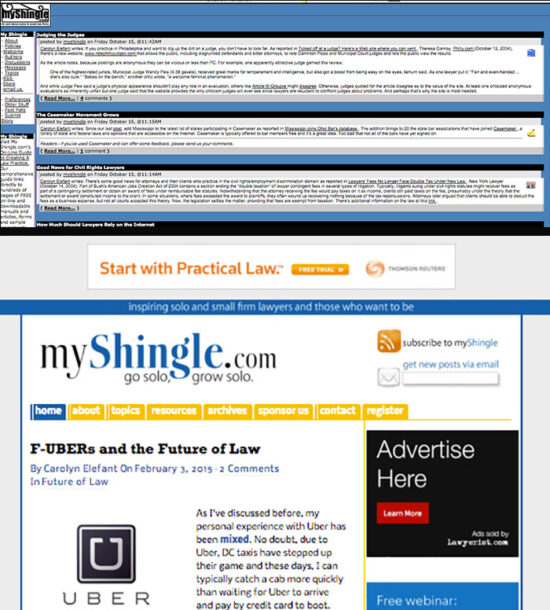
As readers may notice, My Shingle has gotten a bit of a facelift — as it has over time – morphing from how we looked ten years ago to two weeks ago to the present. Ultimately, technology rather than design sensibility forced my hand: when Google announced last spring that it would take account of
Opening a Small Firm – How to Survive the First Three Years
The following is a guest post by attorney Branigan Robertson.
Starting a law firm isn’t easy. The first three years are the toughest. I opened my employment firm three years ago and it has certainly been a wild ride. Looking back, I realize now that most solo lawyers can survive on their own with a
Does Reciprocity Help or Hurt Solos: The Florida Bar Debate?


Earlier this week, the Florida Bar tabled a controversial proposal to adopt reciprocity or some other form of admission on motion, reports The Daily Business Review. The proposal — intended to bring Florida in line with the 40 states that allow admission on motion — sparked a firestorm amongst bar members, particularly solos and
Seasonal Marketing: What’s Your Firm’s Pumpkin Spiced Latte?

Updated August 31, 2022
Orange may be the new black – but come fall, it’s also the new green – or more accurately, a new source of green (as in dollars!). Today, Starbuck’s pumpkin latte returns to stores for the autumn season. And it doesn’t stop there: ever since the ubiquitous coffee chain introduced the
21st Century Ethics Q&A: Can You Bill Clients for A Virtual Receptionist?
From Lawyerist Lab, a commenter asks whether he can charge clients for costs associated with an outsourced answering service – in his case, Ruby Receptionists. The answer – probably not.
Why Lawyers Are Slow To Adopt Legal Tech: Because It Often Sucks, and Isn’t Worth Risking Our Law Licenses.
Over at Law Technology Today, Mary Juetten ponders why the legal profession is slow to adopt new technologies. Here’s the perspective of a practicing small firm lawyer who has been a relatively early tech adopter.
Trial By iPad: 1 New Technology, 10 Days, 3 6-Figure Verdicts
As I’ve described before, I consider myself a practical technologist – I choose tech tools based on cost and what they can do to help me right now rather than paying top dollar for the latest-and-greatest gadgets that may not work for my practice. Likewise, I track technology on a “need to know” basis – keeping abreast of developments that I might need, instead of staying on top of everything that’s out there.
So two months back, when I began prepping for my first jury trial in more than a decade, not to mention my first in federal court, of course, I was aware of the iPad as an option for trial technology. But with my focus largely on appellate work (where I limit my notes, if any, to a single page of paper) or pre-historic regulatory hearings (in one case, we were assigned our own blue plastic tub to store the hundreds of pages of paper documents circulated each day), I realized that I’d fallen behind on modern trial tech and needed to get up to speed – and fast. So here are the steps that one iPad novice took to ensure a smooth and seamless maiden voyage with my iPad at trial.
Message to Moms: New Law Is Not A Permanent Career Option – You Need to Own It
For the second time in just a month, the media has anointed AltLaw as the savior for lawyers – particularly women – who want to parent and practice.
Back in August, the Harvard Business Journal profiled various “new law” models that gaining traction as alternatives to the big law partnership track. And just today, The Atlantic touts many of the “new business models” that assign freelance lawyers to temporary gigs – companies like Montage Legal or Bliss Lawyers – as a middle ground for women who want to raise families but don’t want to leave the law either.
Call me skeptical. It’s not that I don’t support new law ventures like Bliss or Montage. To the contrary, I’m a huge fan because these models make legal services more competitive and affordable, while offering career options that have always been available (see, for example, Lisa Solomon, an independent freelance lawyer who’s been in business for two decades), but were not necessarily as accessible. But viewing these models from the perspective of the women providing the services, I’m not convinced that they offer a viable long-term career path for women who want to parent and practice, as these recent news stories suggest.
To begin, how many women can these new law models actually place? The Atlantic piece says that Bliss Lawyers draws on a network of 10,000 women for secondments to law firms and corporations. Yet, even if Bliss is dispatching women on massive document review assignments (which doesn’t appear to be the case), it can’t possibly be keeping more than a small fraction of its network members busy. Who wants to be in their 50’s, hanging out by the phone waiting for an assignment to come in?