Earlier this week,Avvo the first online lawyer rating site announced another round of funding – to the tune of $71.5 million – to expand product offerings and bring on new hires, reports the ABA Journal.  News of Avvo’s expansion brought the usual grumblings on some of the lawyer list-serves where I participate – ranging from valid criticisms of Avvo’s various services (such as whether Avvo’s for fee PRO listings yield a favorable return on investment)to rants about how Avvo serves no valid purpose but to take advantage of desperate lawyers and line its own corporate pockets.

No valid purpose? Really?  Take a look around.

In the nine years since Avvo was founded, sites like Amazon, Yelp and TripAdvisor have grown steadily, affording consumers access to a rich database of reviews on books, restaurants, hotels, and a vast array of technology and household products. Consumers crave this kind of feedback – the chart below from Google Trends shows the increase in searches for “lawyer reviews.”

As with the legal profession, medicine is rapidly changing, driven by technological advancements, cost pressures and physician shortages.  Healthline reports on some of the  new business models cropping up in response.

One company, Turntable Health is a subscription service. A flat fee of $80 per month buys an adult an unlimited amount of monthly visits – not just with doctors, but also health coaches or participation in yoga and healthy cooking classes.  Another service, Heal will dispatch a doctor and medical assistant for a house call, perform bloodwork or tests and authorize a prescription if needed – all for $99.

The new business models serve several goals. First, they make reduce the cost to access a doctor, so even those individuals with high-deductible health plans can still afford a visit. And in turn, by encouraging individuals to seek treatment for minor problems, these new services can resolve these matters before they become more serious and more costly to treat.

Thanks to technology, advance directives- legal documents that specify what actions should be taken if patients are no longer able to care for themselves – are readily available. Free advance directive forms abound online at sites like this, while those who don’t care to read through lengthy instructions can create an advanced directive at Legal Zoom for 39 bucks simply by checking through a couple of boxes.  So isn’t the story of advanced directives Richard Susskind’s vision come to life: freely available, do-it-yourself legal documents that don’t require a lawyer.

Except for one thing. Turns out, that advanced directives prepared by rote, while entirely legal are also completely useless. And what’s more, it’s not ye olde legal guild criticizing advanced directives, but doctors who first-hand view of how advanced directives actually work – or don’t work – in practice.

Both my firm and this blog, MyShingle.com are sponsoring 2-3 paid, 6-week fellowships this summer for rising 1-Ls or 2-Ls.  The position is posted online here. You can apply either through that site, or directly to me by sending the required materials to elefant@myshingle.com. The positions start May 25, so I’m accepting applications

If you’re looking to steal a rival law firm’s Google Thunder, the coast is clear (except in North Carolina) opines Professor Eric Goldman in a soon-to-be-published SSRN article, Regulation of Lawyers’ Use of Competitive Keyword Advertising.

Goldman explains that use of a competitor’s name as a keyword violates neither publicity rights nor trademark law, noting that “no trademark owner has achieved a courtroom victory in a competitive keyword advertising lawsuit since 2011.” As for legal ethics codes, Goldman takes the position that use of a competitor’s name as a keyword is not deceptive because it does not create the impression that the lawyer has any affiliation with the competitor. Moreover, Goldman points out that when consumers search a law firm name, they are often looking to find competitor ads, so “competitive keyword advertising is consistent with their expectations.”

Nevertheless, in 2010 Formal Ethics Opinion, North Carolina banned keyword ads by lawyers, finding that:
The intentional purchase of the recognition associated with one lawyer’s name to direct consumers to a competing lawyer’s website is neither fair nor straightforward.
Florida, however, took the opposite approach, and allows competitive keyword advertising so long as the resulting links are clearly labeled as advertising.

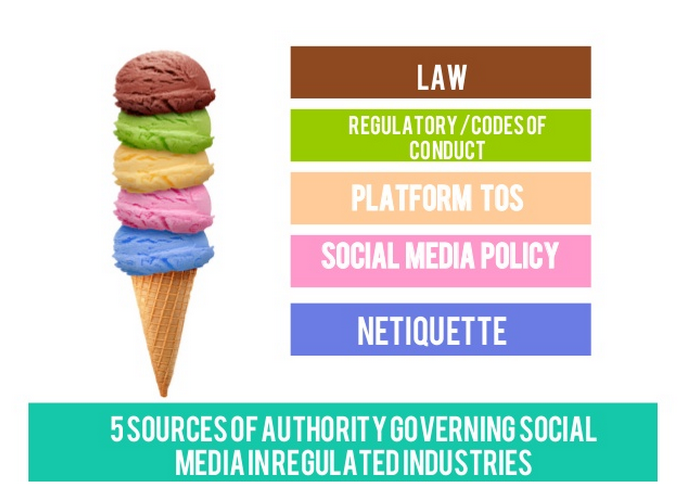
Like law, the energy and utility industry where I spend my days has traditionally been heavily regulated.  What that means is that rules for participants or relief for consumers come by way of regulatory commissions rather than statute or contract. But that model changed when utilities dipped their toes into social media where as this slide (from one of my presentations) whimsically illustrates, regulation accounts for only one fifth of the authority that companies must abide.

Likewise, as legal technology advancements enable more digital and dynamic law practices, lawyers cannot depend on legal ethics alone to govern our conduct. Instead, now that we lawyers are playing in the real world of digital commerce, we’re subject to real laws on deceptive advertising, data breach disclosures, customer privacy  (for firms that harvest big data), independent contractor laws  (for lawyers who rely on freelance help) and terms of service  (for anyone engaging social media or other third party platforms).  

Although employment prospects for new law grads are showing signs of life, overall post-graduation employment remains at a dismal  56 percent average rate for all law schools.  And while connections, solid skills and networking can improve the odds of finding a position , your best bet for finding a job after law school may just be to bet on yourself.

That’s what enterprising University of Pittsburgh 3-Ls, Marlene van Es and Jaclyn Clifford are doing, reports the Post Gazette. Come November 2015 when they’re licensed to practice, the pair will hit the ground running at Trellis, an unconventional law firm that will specialize in urban agriculture and food policy.  Already van Es and Clifford are showing that they’re as much entrepreneurs as lawyers, availing themselves of start-up competitions and crowd funding sites (I was so inspired that I contributed here) and devising unique pricing structures like subscription models (to do it ethically, see my post here).

The New York Journal reports on a recent Court of Appeals ruling interpreting NY Judiciary Law §470 as requiring attorneys who are not residents of New York to maintain a physical office in the space to practice. That physical office requirement means a real space – not a kitchen table or a corner in Starbucks. The requirement only applies to non-resident lawyers, New York attorneys who reside in the state aren’t similarly bound.

So how come I’m not criticizing this apparently idiotic ruling as I did five years ago when New Jersey issued a similarly restrictive reading of the bonafide office requirement (which has since been changed)? Because the New York Court of Appeals ruling is the first step towards the long and exceedingly slow journey to its demise.

More than six years ago, New Jersey based shingler Ekaterina Schoenefeld  challenged the constitutionality of New York’s office requirement, arguing that it violated the Privileges and Immunities Clause of the United States Constitution, imposing undue burdens on out-of-state New York attorneys’ ability to use their New York bar license.  

Tales about  clients from hell abound. Visit any lawyer listserve and you’ll encounter weekly threads populated with complaints about crazy clients or advice on how to fire them. Bad clients aren’t exclusive to the legal profession either – doctors deal with them and one designer even set up a Clients from Hell website dedicated to them.

Don’t get me wrong – I enjoy the horror stories, not to mention the shared sense of camaraderie that they breed, as much as anyone. But aside from the cathartic benefit for the lawyer, client-from-hell stories aren’t all that useful in changing behavior. After all, many clients from hell either don’t recognize themselves in the story – or don’t understand why certain conduct may be counter-productive.

So I’m posing the question to all of you: what makes a great client?