A few weeks ago, I earned $1000 for a couple of hours offering some insights in my practice area. While certainly not a large enough fee to close up shop for the month, it was a tidy little windfall that helped cover some home repairs that I’d put off for a while.

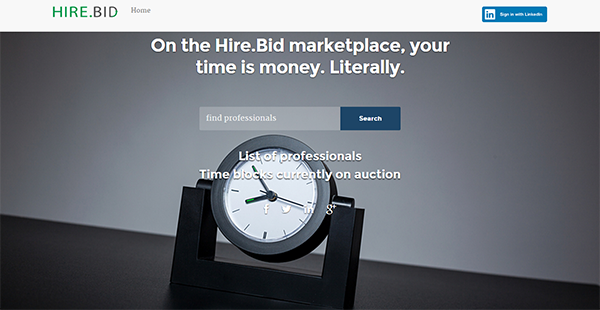
What if there were a way to regularly convert legal expertise into extra money? Now there is, with a new platform, launched at the end of 2014, called Hire.Bid. The brainchild of Neil Sandu, a lawyer and technologist who conceived of and developed the site, Hire.Bid:

allows professionals in the U.S. to auction their available time (whether on nights, weekends, or otherwise) to be bid upon by prospective clients needing a helping hand on anything from complex matters to simple tasks.
So how is Hire.bid different from the myriad of on demandauction or legal consults on the spot platforms cropping up ever day? Well, for starters, Hire.bid though started by a lawyer isn’t limited to lawyers – so you can find web developers, financial analysts, graphic designers and other professionals. Second, service providers set the price for their services rather than the platform setting rates or extracting discounts.

What’s the most effective way for lawyers to protect their clients from a data breach of  Sony-like magnitude? Sure, they can sponsor trainings for clients, develop handbooks and checklists and purchase cyberinsurance. Or lawyers could take the most direct approach and identify and plug the security gaps themselves.

Sounds crazy – and outside a lawyer’s pay grade. Yet, Chris Cwalina and Steve Roosa, two Holland & Knight attorneys have built a practice area within their firm on that very concept. As the Washington Post describes (sorry, this story is from August 2014 – a bit dated for me), Cwalina and Roosa have created a “lab” that they use to research and test apps and websites of their clients to detect security lapses. Cwalina and Roosa don’t appear to have technical expertise (though Cwalina was in-house counsel at ChoicePoint, one of the first companies to disclose a massive data breach a decade ago), they work with a team of paralegals and tech consultants to create the testing environment. Once familiar with vulnerabilities, the lawyers can plug them. In addition, through hands on use of these technologies, Cwalina and Roosa can gain an idea of what types of procedures for protecting security are practical and feasible.

The firm charges a flat fee for this service. Presumably, fee-splitting rules aren’t invoked because the lawyers team with IT professionals employed by the firm who are paid a salary rather than allocated a share of the fee.  

To me, there’s nothing more depressing than the concept of the staycation  – essentially, spending valuable days off from work hanging around the house and area where you live. Sure, I get the concept of local sightseeing (I live in the tourism capitol after all) but that’s what visitors and houseguests are for. To me, vacation means getting away – far, far away.

Still, as a small law firm owner, I realize that true vacations aren’t always possible. Even if you can successfully master the planning, a trip of sufficient duration — i.e, more than a three-day weekend — can be costly and often not worth the effort when a pile of work awaits upon return.

Having wrestled with this conundrum myself, I was intrigued to learn, via the New York Times  of co-working vacations. As the article, by Tanya Mohn describes,  

Once upon a time, law firms used wills as a loss leader. Clients would come to a law firm for a free will and in theory, the firm would have first dibs on the more lucrative probate work when the time came. These days, free contracts are the 21st century version of free wills with lots of large law firms making corporate documents, term sheet generators and other types of documents freely available, reports Tech Crunch. Only today we’d call them lead generators and not loss leaders because they bring clients to us.

Free law firm contract offerings aren’t new; I blogged about big law free platforms like this over five years ago. What is new is that law firm free now faces competition, the Tech Crunch story continues. That’s because entrepreneurs can also find free contracts at sites like Docracy, Clerky or Shake which likewise offer free tools. In fact, why even bother to pay $99 for a contract from Legal Zoom when they’re free? 

Seven participants in Florida International University (FIU)’s LawBridge program which provides incubator space to lawyers willing to do low bono work recently got a rude dose of reality when FIU was bumped from its donated space by a large law firm that presumably could pay rent.  Without free space, the FIU program leaders can’t figure out what to do – they’re considering retooling the program to no longer offer office space, but instead, just advice through weekly CLEs (as if there wasn’t already anything like that online already).

Meanwhile, the lawyers installed in the space, many subsisting on a heavy diet of low bono work are scrambling in search of new digs.

Don’t get me wrong – I feel badly for the lawyers who now unexpectedly need to budget for what was previously a low cost budget space. But as I’ve always worried that the low-bono-for-free-space incubator model wouldn’t lead to sustainable practices, and indeed that may be the case. For example, consider a quote from this disappointed participant:

Back in the dark ages when I started my law firm, I took advantage of unemployment benefits to help pay the bills. I’d been working five years before a layoff lead me to hang my shingle, so I figured that I’d paid enough into the system to deserve some support. Although my unemployment benefits maxed out at the princely sum of around $250 back then, the money enabled me to cover my virtual office expenses, a few substantive legal guides and to avoid having to forbear on my student loans for more than three months.

I collected unemployment legally. At that time, the District of Columbia only required unemployment beneficiaries to state that they were seeking employment (which I could truthfully state since I continued to interview for jobs and seek out contract work) and to report any earnings since these would reduce the amount of unemployment that could be recovered. That’s not necessarily true in all states – several years back, New York determined that a laid off lawyer who started a payment-generating blog was running a business and therefore wasn’t eligible for benefits.

So why revisit the issue of unemployment insurance after all this time? 

If you haven’t noticed, I haven’t posted since December 19. Three weeks ago. And last year too! That’s a huge gap for my blog, probably unprecedented. But life interrupted, and between a heavy caseload and my college daughter’s return from break, I’ve been too busy or too tired to blog.

But I’m feeling reinvigorated. Like

Do your or your law firm have a succession plan? If you don’t you’re not alone. CNBC reports that a majority of financial advisors — more than two thirds – don’t have a succession plan for their own business – and that’s actually one of the tasks that they’re paid to handle for clients.

You might be wondering why you even need a succession plan. After all, if you’ve manage to squirrel away a few bucks each month for a little nest egg, then when you’re ready to retire, why not simply slow down your intake, refer out any active cases and shut your shingle down? And while certainly, that’s one approach, it doesn’t position you any better financially than if you spent years working for others.

The real value in running your own shop isn’t just in the flexibility and autonomy – although those are certainly important. Rather, just as with owning a house, owning a firm gives you an opportunity to build up equity so that when you decide to shut down, you can cash out.

But how? There are several approaches.  One way is to ease your way out, by bringing associates on board to take over your cases, and devise an arrangement for them to keep you on as of counsel for a salary for several years. Or, you could simply sell the entire firm outright.  When it comes to law firm sales, Ed Poll and Roy Ginsburg are two of the go-two guys in the area. In fact, Ed even operates a Law Firm Registry for lawyers seeking to list a firm for sale, or to find one to buy.

In May of 2014, Jordan Furlong published a comprehensive list of the universe of NewLaw business models – some that increase lawyers’ efficiencies, others that marginalize or eliminate the need for lawyers. But even though 2014 may have been a watershed for #newlaw, it was an even bigger year for new law, no hashtag.

What I mean by new law, no hashtag is law uninvented. Precedent not yet written. The kind of law where an old fogey like me doesn’t have any inherent substantive advantage over a newbie just out of school.

In all of my years of blogging, I can hardly recall a year with so many emerging issues on the horizon. Some arise out of new technology developments – like the legal issues associated with wearable tech or drones (which also raise ethics issues ) for lawyers. Others have resulted from policy changes, such as liberalized marijuana law or legalization of same sex marriage.

There have been zeitgeist changes too such that we’re more comfortable with the sharing and crowdsourcing. The freelance economy raises a whole new set of employment issues – and as Uber has disrupted traditional regulated taxi services, it’s become a veritable first year issue spotting exam on criminal law and liability, insurance law, price gauging and regulation.