Above the Law columnist Elie Mystal asks: should nasty commenting trigger an ethics probe? Absolutely not.  Moreover, as a vocal blogger often critical of ethics regulators and a practicing attorney dependent upon my law license for my livelihood, the fact that a law professor, of all people, would pursue this kind of action against a pseudonymous loser creep too cowardly to comment under his own name and not worth the time of day, scares me to death.

I’ll share my concerns in a moment, but first some background. For those unfamiliar, Nancy Leong is a law professor at the University of Denver whose scholarship, as well as her gender and race (in her view) was the subject of persistent criticism and ridicule by a commenter going by the pen name “dybbuk.” Frustrated by what she viewed as harassment, Leong did some digging, easily uncovered the commenter’s identity as a public defender in the Chicago area and after first attempting to speak with him personally, filed an ethics complaint against him in Illinois.

Professor Leong’s decision to file an ethics complaint against the commenter sets unspeakably bad precedent for bloggers exercising their First Amendment rights. The barriers to filing an ethics complaint are exceedingly low, and Professor Leong’s complaint will invite frivolous complaints.  There’s no filing fee for submitting an ethics complaint and no need to retain an attorney either. There are no discovery costs; the grievance committee will investigate the action for you.

I frequently criticize ethics regulators and other attorneys, as do many of my fellow bloggers.  Although I try to keep it professional, the subjects of criticism often take it personally.  I’ve been sued for defamation over a post that I considered relatively innocuous. Still, it was one thing to have to shell out a few thousand dollars to hire the best lawyers ever to get the case dismissed. What if anyone annoyed or angered by my posts could file an ethics complaint against me? I don’t intimidate easily, but the prospect of a black spot on my otherwise (knock on wood) pristine ethics record scares the heck out me.

You had the best intentions for celebrating your clients and colleagues this holiday season.

First, it was branded calendars or chargers or thumb drives for clients and colleagues as a holiday gift, but your budget couldn’t quite cover it.  So, you downscaled to printed holiday cards but you didn’t place the order in time. Then, you considered an informal holiday party or lunch but discovered that between family obligations and other professional commitments, you couldn’t find a date that didn’t conflict.  And now, as 2013 draws to a close, you realize that it’s going to end just like the past three or five or fifty years, with yet another goal that you didn’t make good on.

But it’s not too late. Even now, on December 20, with holidays just around the corner and folks scrambling to leave town, there’s still a few things that you can do to reconnect and show your gratitude. Here’s a couple of suggestions:

Send a handwritten notes  Even if you didn’t have time to pre-order holiday cards, that doesn’t mean it’s too late to send them. After work today, head out to a local stationary store or even a Target or Walmart and pick up a box of notes and a nice ink pen. Then tonight or this weekend, pick a comfortable spot at home or even Starbucks (this is one task that even a Grinch would agree can be done at a coffee shop) and start writing.  Maybe you want to thank a colleague for his advice over the past year or let a client know how working with her was the highlight of your year or maybe you want to reach out to a mentor whom you haven’t been in touch with in ages. No matter what you write, make it personal and genuine. Sure, your holiday cards may not look very attractive – but I guarantee that your clients and colleagues will much prefer a handwritten note to a fancy card with signature.

Pick up the phone  Okay, so no time to even write cards. You can still pick up the phone to say hello and offer holiday wishes by phone.

The Annual Report If you want to provide something of value to clients and contacts more so than holiday wishes, how about an annual report? Not a report about what your firm has been up to but rather, a round-up of important cases or industry trends in review. Each year, I devote the final edition  of my law firm newsletter to predictions for the coming year and a round up of the two dozen appellate decisions involving review of FERC orders with links to the underlying case. I’ve gotten lots of good feedback on the usefulness of my year end newsletters – plus putting them together ensures that I’m current on the past year’s events before moving forward.

Though it may surprise you, I’m not a fan of lawyers describing themselves as solos. Despite eleven years of promoting the virtues of hanging a shingle  and big law’s tarnished image, the legal profession — from law schools to judges  — still reveres big firm lawyers and their shiny credentials. Even the so-called  Newlaw darlings like Axiom sell big law pedigree. That bias? Never gonna change.

For this reason, I’ve never referred to myself a “solo practitioner” even back in the day when my firm consisted of just me. Instead, I dubbed myself an “independent practitioner,” or simply stated that I owned my own law firm firm — a designation that the D.C. Bar albeit reluctantly allows individual practitioners to use.  Because of my aversion to the term solo, I cringed when Lee Rosen’s blog post  reminded me that I’d described one of the MyShingle’s purposes as a site to celebrate the joys of solo practice. Looking back at the context, I think I must have used the term solo as a rough shorthand for “starting a practice” which indeed, is why I continue to use the term solo even though I don’t like its current negative connotations.

Lee’s post invites bloggers to discuss What’s a Solo Practitioner?, a question that Lee writes has long vexed him. As Lee points out, the term solo can encompass scenarios ranging from lawyers who practice by themselves with no help from others to those who outsource for answering services or virtual assistance to those who hire assistants, paralegals, associates. Where do you draw the line on what constitutes a solo – and does it matter? 

Let’s say that you need a website for your law firm and you’re on a tight budget. So what are the options?

You can’t afford some of the high-end, reputable vendors that serve law firms exclusively — and you’re not interested in a usurious three-year installment contract where you pay a small fee up front but lock into monthly “maintenance” payments of several hundred dollars for three years or more. On the other hand, you haven’t been all that impressed with some of the more moderately-priced mass produced options cloaked in drab browns and grays, gussied up with cheesy stock photos. And while you’re tempted by the seemingly user-friendly and appealing free and freemium options for BIY (build your own) website development (such as  Wix  or Weebly or you’ve heard that WordPress is “real easy” to use, you’re not sure that you have the skill or the patience to figure out how to use the tools to produce a professional-looking site.

Still, just as is true for legal service, when it comes to web development, there are many options between DIY and premium design. One approach you might consider is what I call guided design – where you employ a web developer but keep costs down by specifying the format, design, color and font choices that you want in advance. And one way to figure out exactly what you want is to have a look at other websites and take a peek under their codes.

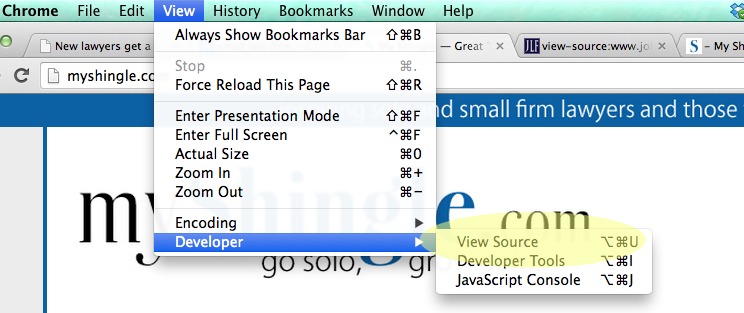
Thanks to browsers like Google Chrome, you can figure out a lot about a website’s structure without ever speaking with the developer. Once you’re in Chrome, click on “View” from the menu bar, then choose “Developer,” then “View Source.”
 
If you search through the code, you can see if the designer used WordPress (indicated by WP) or a WordPress Framework  (like Genesis or Thesis) or a particular theme (like the Organic Theme Bold Blue ) shown below on the code snippet from the Ocean Renewable Energy Coalition website. 

Sometime in the evening of December 9, 2002, I clicked the enter button and launched MyShingle’s inaugural post into cyberspace. My blog has created some great opportunities — but eleven years is also a long, long time to be blogging. Each year, more blogs emerge and it becomes increasingly difficult to stay relevant and keep

Tis the season for trend spotting! As the year winds down, predictions of hot practice areas and the future of law will cram the legal trade press and blogs.  In fact, Bob Denney has already released his always excellent annual “What’s Hot and What’s Not” over at
Attorney at Work; if you only have time for one trend piece, I commend Denney’s.

Though I’ll also release a trend paper later this month, here’s what I suggest if you want to trend spot. Instead of sitting down with a bunch of blog posts and data, call a few colleagues and book a week’s worth of lunch dates at area restaurants where you’ve never been — from casual to upscale.  The meetings offer an opportunity to network, but that’s just an ancillary benefit of my proposed exercise. Rather, the real value of visiting these establishments is to gain insight into next year’s trends.

More than any other analogous industry, I’ve found that the restaurant biz acts as an uncannily reliable barometer of where the proverbial puck will be next year. It’s true for several reasons, I think. For starters, virtually everyone — from consumers to business folk – eat out, and so restaurants offer insights that apply to a variety of law practices. In addition, the restaurant business, at its core, is a service industry, as is the legal profession.

I’ve written about restaurant trends as they pertain to law practice several times.  In 2011, I noted the hyper-local  restaurant trend and its relationship to a sustainable legal practice (since local lawyers with strong community ties are less likely to be replaced by Legal Zoom and online providers). Likewise, the trend at my local WholeFoods of identifying the source of each type of produce  suggests a growing consumer interest in transparency as well as a desire for a more personal relationship with providers. Even restaurant design and branding can yield clues; back in 2012, I wrote about the discernible rise in use of graphic design on restaurant menus  and described the relationship of graphics to law, as evidence by Nathan Burney’s Illustrated Guide to Law. This year, lo and behold, there are at least  two law schools focusing on design thinking and the legal profession.

The problem of lawyers abandoning a practice and leaving clients in the lurch is hardly new. Yet abandoned law practices are increasingly becoming a crisis for the legal profession reports Cincinnati Enquirer and Lexington Herald.

In Kentucky, a recent tragic spike in the number of lawyer suicides  (six in 2012 alone) galvanized the bar’s attention on abandoned law practice, but the problem is national.  In a weak economy with unemployment still high, some jobless lawyers hastily hang shingles only to ditch them when steady paying work comes along, while older lawyers practice who past their prime because they cannot afford to retire may become incapacitated or die without a succession plan. And of course, financial stress can result in alcoholism, addiction and depression which takes a toll on a practice.

Naturally, “the overriding concern of the courts and the organized bar is the protection of clients who might be harmed when a law practice is abandoned for whatever reason, “according to William T. “Bill” Robinson III, a past ABA president. So the ABA and states have encouraged lawyers to adopt contingency plans that would designate a surrogate lawyer with authority to review clients files and notify clients of the lawyer’s death. Recognizing that may lawyers may not be proactive, states like Indiana adopted a rule that appoints retired judges as surrogates when lawyers in solo practices gets sick, die or abandon their clients and also allows for a four-month suspension of all deadlines in the cases picked up from abandoned practices. But be aware, many other jurisdictions do not provide for comparable arrangements, note Courtney Kennaday and Reid Trautz.

Still, many bar associations do have succession planning guides like this one (from Missouri) with forms and checklists that lawyers can use to designate back up lawyers, appoint a successor and list passwords and instructions for accessing accounts. Although some of the information is state specific, most of the forms can be used in any practice if your state bar does not have its own materials.