
In August 2003, roughly nine months into blogging, I crossed the line between professional and personal when I posted this picture of my daughters and me at MyShingle. I recall actually fretting over whether to put the picture up or not – because even though the legal blogosphere back then was small and full of

It Took Solo To Take Prenda Down
Yesterday, federal judge Otis Wright slammed Prenda, a rogue “porno trolling” quasi-law firm that figured out a formula to get rich in the Internet Age. As Judge Wright uncovered , Prenda bought copyright interests in porn movies, placed them in shell corporations to appear as if they were owned by clients (rather than Prenda lawyers) – then brought boilerplate copyright infringement actions against individuals suspected of having downloaded the porn and extorted hush money to make the cases go away. Finding that Prenda had exploited “antiquated copyright laws, paralyzing social stigma and unaffordable [legal defense] costs” to “plunder the citizenry,” Judge Wright came down hard, awarding double attorneys fees and referring the attorneys to ethics committees, the U.S. Attorney and the IRS for investigation. (For detailed coverage, See Popehat).
Even though Judge Wright pulled the trigger on Prenda, it took solo – in this particular case Manhattan Beach, California based Morgan Pietz to make the Judge angry enough to pick up the gun. In a lengthy affidavit, Pietz, aggregating information on Prenda’s activities in other courts, systematically connected the dots to paint a picture Prenda’s unlawful acts, culminating in its theft of an innocent third-party’s (a property caretaker for one of Prenda’s principals) identity to use front for one of its shell corporations. Though solo, Pietz didn’t defeat Prenda all on his own; a small army of solo and small firms mobilized nationwide to defend Prenda’s (and other trolls’) victims. Presumably, these firms also collaborated and shared documents that eventually exposed the Prenda and lead to its demise.
As with the mortgage foreclosure fiasco (a fraud that resulted in thousands of evictions based on robo-signed documents) the Prenda travesty shows why, more than ever, we need solo.
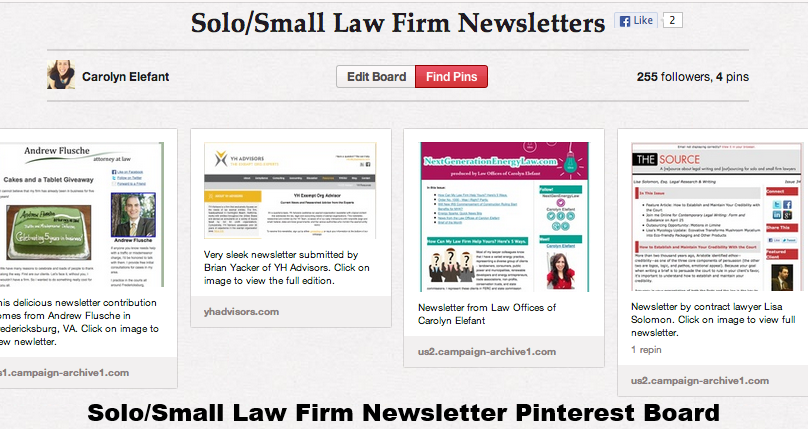
All the News[letter] That’s Fit to Print
Even in the age of social media and blogging, the humble law firm newsletter still matters. Consider this:
1. Newsletters offer a way to stay connected with current and prospective clients. While a law firm Facebook page serves that purpose as well, many people prefer to keep their personal recreational time on Facebook separate from business – and thus, won’t like a Facebook page. And depending upon the nature of a matter (e.g., criminal, domestic violence), some law firms will advise clients against liking a law firm Facebook page since doing so could reveal that the client has retained a lawyer.
2. Newsletters offer content without the same level of commitment as blogging. Unless you really, really like to write and love the topics you’re covering, blogging can eventually become a chore. Here at MyShingle, I can churn out content like a pro but even I’ve met my Waterloo in covering complex energy regulatory matters on my law firm blog.
3. Newsletters offer more opportunity for creativity and personal sharing. Generally, a blog is either part of, or at least linked to a law firm website. Since many lawyers, particularly those who compete for corporate clients, prefer to maintain a more formal presence on their websites, they’re hesitant to share information about family or hobbies on their blog. By contrast, newsletters are, by their nature, slightly more intimate (since they’re not necessarily posted all over the web) and as a result, lawyers are more comfortable including personal tidbits.
4. Newsletters allow for more in-depth coverage. I’m not a fan of the 3-paragraph, “top 5 reasons….” blog post. At the same time, I have a hard time scrolling through a 10-screen post analyzing a complicated regulation. Because it’s a discrete document that can be easily printed or saved, a newsletter provides a far better forum for lengthy posts than a blog.
Why We Choose Solo Practice
This is one of my favorite scenes from A Civil Action . Billed as a book (and movie) about a class action by an underdog lawyer against a major corporation, A Civil Action is also, somewhat unintentionally, one of the very best books about solo practice, covering the tumults and the triumphs and the dichotomous…
A Public Apology: Webinar Cancelled Due to Anymeeting.com’s Terrible Service – But I’m to Blame As Well.
I am so, so sorry that I have had to cancel today’s free webinar on how to launch and lift a 21st Century Practice. The immediate cause of the cancellation is that the Anymeeting.com platform crashed – my assistant, more than 100 participants and I were locked out of the site. I’ll trash the service thoroughly in a minute. But first, my own mea culpa – ultimately, I stand responsible for the failure because I should have had a back up plan.
And in fact, three years ago, I would have. When I started offering webinars back in 2010 or even earlier, I would circulate a phone number from freeconferencecall.com and a PDF of the presentation in addition to the web platform information. Flash forward to today, and I have enough webinars under my belt, either on my own or with the expert assistance of LegalTypist Andrea Cannavina (who has helped with 21st Century Retainer Agreement) that I’ve gotten over-confident, and assumed that the technology will work every time. Unfortunately, we’re not there yet.
Does my experience mean that you should trash the cloud or give up your smart phone calendar in favor of a notepad? Absolutely not. At least ninety percent of the time, technology works; it doesn’t make sense to forego its use entirely for the ten percent of the time or less that it’s not available. Instead, use the tech to your heart’s content, but always assume that it won’t work and have a Plan B in place. For webinars, a Plan B means having another platform as backup, or an alternative and more reliable mechanism such as a dial-in phone number combined with a PDF. For presenting at a conference, a Plan B means coming prepared with your own wireless hotspot if you intend to show sites online or including static screen shots in your PowerPoint presentation that you can use if you can’t access the internet. For exhibits and calendars and other materials stored on an iPhone, a Plan B means lugging along extra batteries, powerstrips and connections in case your device runs out of steam. For tablet, Plan B means storing copies of files in Dropbox, Box.net or other cloud-based provider on the device itself so you can access them without the internet.
Ninety-five percent of the time, I employ these best practices (if you’ve ever seen me at an event, I’m the popular gal in the back of the room whose powerstrip makes me a hub of activity). Unfortunately, when I don’t use them, I don’t get credit for the times that I do – I just look bad.
Anyway, that’s my mea culpa – now on to the other culprit, Anymeeting.com. I’ll say it again, Anymeeting.com. I’d chosen Anymeeting.com because I knew that the webinar would attract a large audience and Anymeeting.com offers both a free, ad-supported service and a relatively low priced $69 non-ad service for up to 200 people. And while one “might” be inclined to give a free service a pass, there is absolutely no excuse for Anymeeting.com’s PAID service not to work. It’s utterly unforgiveable.
Low-end Marketing Tip: Keep Your Digital Footprint Fingerprint Free
Sometimes, the best marketing ideas cost the least amount of money.
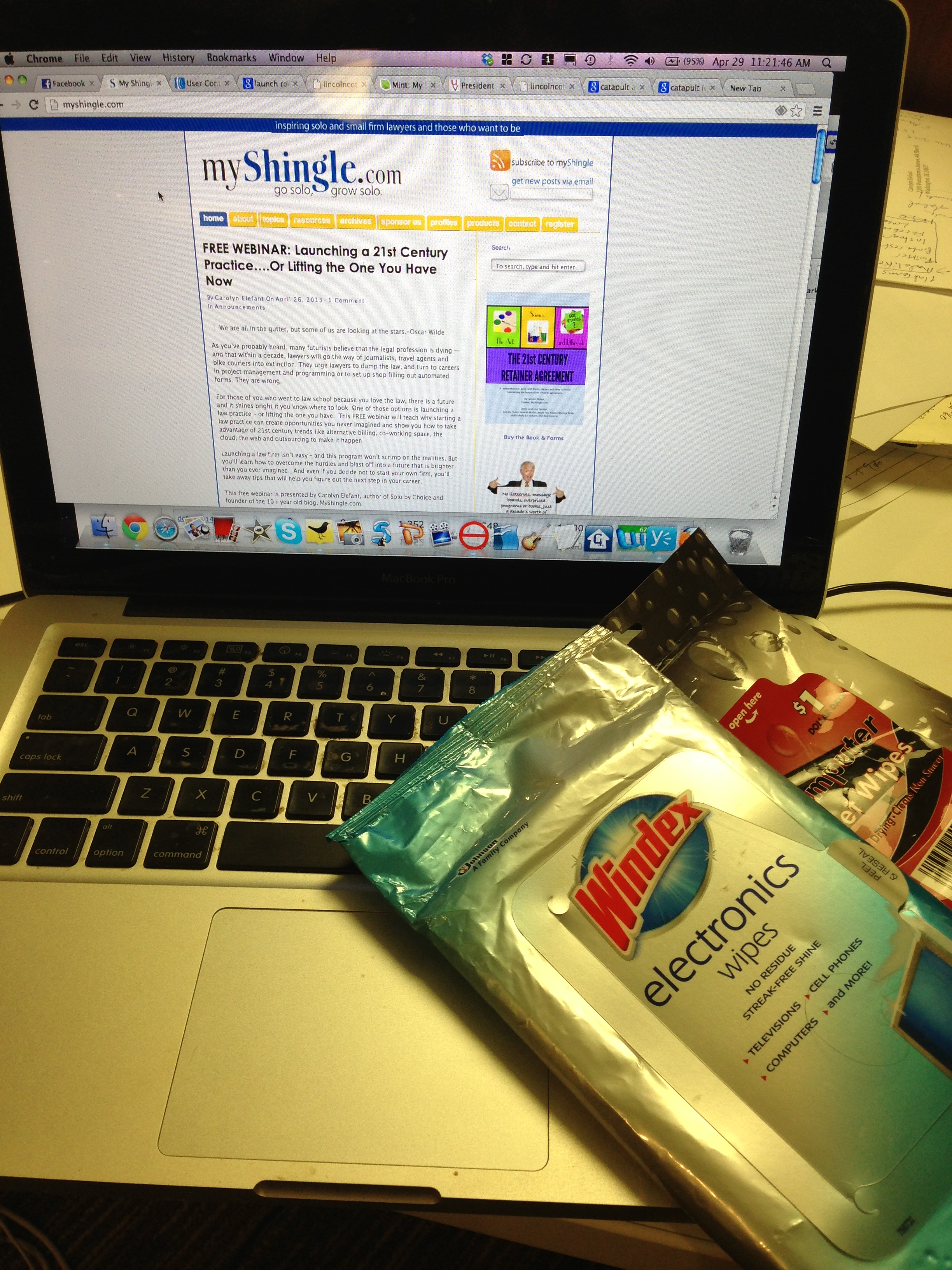
Like trotting out a branded powerstrip at a hearing or conference: it’s a way to connect by providing a useful service (a power outlet) and striking up a conversation in the process. Same with a laptop cover— a great icebreaker and potential business idea for another business owner or prospective client.
These days though, my latest low-end business development accessory is a pack of electronics wipes. As we spend more time using our ipads and iphones, they can pick up dirt, dust and remnants of lunch and kids (especially if like me, you’re inclined to share your devices with a pack of five and seven year old nephews and nieces) – which can be embarrassing if you later opt to share your screen with a client or business colleague. Likewise, colleagues may have the same problem – and offering up a pack of wipes (preferably branded is appreciated. ( Digicleans are also neat but slightly pricier).
FREE WEBINAR: Launching a 21st Century Practice….Or Lifting the One You Have Now
We are all in the gutter, but some of us are looking at the stars.-Oscar Wilde
As you’ve probably heard, many futurists believe that the legal profession is dying — and that within a decade, lawyers will go the way of journalists, travel agents and bike couriers into extinction. They urge lawyers to dump the…
Even In An Online Age, Bar and Professional Associations Are More Relevant To Marketing Than We’d Like to Admit
Longtime readers of this blog know that I have a love-hate (or more accurately, a friend/frenemy) relationship with bar and professional associations. To be clear, my beef isn’t about the services provided to solos: in the past decade since I’ve started this blog, the bars have stepped up – and I’ve watched as the initially scant offerings grew into a steady and never-ending stream of content . Rather, I simply lack the patience for the endless levels of bureaucracy, childish shenanigans and politics inherent in most bar associations. In many associations, just running for an entry level office requires a nomination by a member followed by approval by a committee followed by an election. Scheduling a brown bag lunch involves vetting dozens of friend-of-a-friend-of-a-friend speaker suggestions and adopting the same format (the panel) over and over and over again. Even volunteering for a committee requires endless and persistent emails to frequently unresponsive participants or officers.
Because my time is limited – and because when I’m on a committee I want to do more than sit as a passive member so that I can put a notch on my belt — I’ve often gone off in my own direction. I’ve started a blog, organized my own webinars and occasional get-togethers – and advised others to do the same. Yet I wonder whether my impatience has cost me opportunities – because as much as those of us out here in the blogosphere hate to admit, bar associations — including the ABA, state and local associations as well as subject or demographic specific associations like NACBA or Woman’s Bar Association — for all their foibles, are still relevant and important sources of connections and business.
If you don’t believe me, take a look at the resumes of the solos and smalls who have built sustainable solo practices beyond just one person or just two or three years. I’m willing to bet that most of them have done some significant legwork on bar committees that has lead to increased visibility and referrals (if you’re a solo who’s benefited from association work, give us a shout out in the comment section). Even Tom Goldstein of SCOTUS Blog and a Supreme Court niche-practice who is a bootstraps kind of guy boasts a couple of years of ABA committee service on his resume.
Changing a bar association from within also works better than complaining about it (as I often do). These days, virtual law firms are gaining widespread acceptance – due largely in my view, to persistent efforts by Elawering Task Force by e-lawyers like Richard Granat and Stephanie Kimbro to force change from within.
Iron Tech Lawyer Competition – Report
I left the office on Wednesday afternoon to attend the Iron Tech Lawyer competition at Georgetown Law School. I must confess that after six months of white noise about disruption, rethinking and access to justice as a way to access venture capital, I didn’t have high hopes for the students’ projects, which employ NeotaLogic (a smart-rules based platform that doesn’t require programming expertise) to automate some of the tasks carried out by pro bono organizations.
So to my very pleasant surprise, I was completely and utterly blown away by the sophistication of the tools developed by the Iron Tech Lawyer participants as well as the depth and quality of analysis that went into each system’s creations. Most of the tools – which ranged from a test for minimum wage violations, an evaluation of eligibility for food stamps and (the winner) a test for bankruptcy eligibility – required students to master complex regulatory codes, break them down in digestible rules and map decision trees with hundreds of steps and contingencies.
This work isn’t sexy and it’s rather modest in scope — in contrast to the hyperbolic change-the-world proclamations of many legal tech start-ups. But it’s important and sound and a world apart from the type of beta garbage that’s coming out in full force now that Lean Start Up has been popularized (as an aside, Lean means minimum VIABLE product – not minimum virtually-a-product). So what does this all mean for solos, law schools and the legal profession? My observations, after the jump:
Tax Day: A Reminder of The Ups and Downs of Solo Practice
With 2012 taxes now complete, I’ve officially marked the last action of the worst year of my practice in a half-decade. While I won’t discuss everything that went wrong, the problem is pretty obvious: more money out, less money in. In my case, an office upgrade and more personnel took a bit of a toll on the expense side. But the bigger hit was a decline in revenues. This year, I had fewer retainer cases (where I’m paid a set fee every month – a great hedge against ups and downs), more anticipated cases not coming to fruition along with more matters resolving more quickly than expected (even though I bill flat fees, they are often phased, so if a case doesn’t proceed to a second phase, I don’t earn as much).
While bad years can always happen, the best part of being solo or small is that there’s an opportunity to fix a situation before it heads too far south. On the other hand, that also means that we alone are accountable for our failures – and thus, I blame my bad year on networking and marketing — which I eventually stepped up late in the year after finally realizing how things were heading. One thing I won’t do, however,excuse my performance in light of the stagnant economy or sequestration; factors which do take a toll on many DC-based practices. It’s my bad for not coming up with a strategy to capitalize on or at least mitigate the effects of the downturn. So long as at least some of my competitors are making money (the others are calling me and asking for work), there’s no reason why I shouldn’t be in that camp either.
Still, I’m not going to be too hard on myself. Because ups and downs are part of what happens when you trade a steady paycheck for your own practice. You can plan and market and work as hard as you can – but at the end of the day, there’s always a risk that things won’t go as planned or that you’ll have to take two steps backwards before moving forward again.