When I’m asked how solo and small firm lawyers can compete with Legal Zoom, my view is that free is the best revenge. Now that legal forms are digitized, it’s only a matter of time before they’re available free everywhere.  If forms are free, companies like Legal Zoom have nothing left to sell — whereas we lawyers can provide advice and guidance to clients.

So it’s no surprise to me then, that Legal Zoom is suing Rocket Lawyer over free, or more accurately, deceptive use of the term free to describe services like incorporation which still cost money (because of filing fees). RocketLawyer is fighting back, asserting that LegalZoom copied Rocket’s attorney subscription plans (as if these hadn’t been around since the 1970s with pre-paid legal).
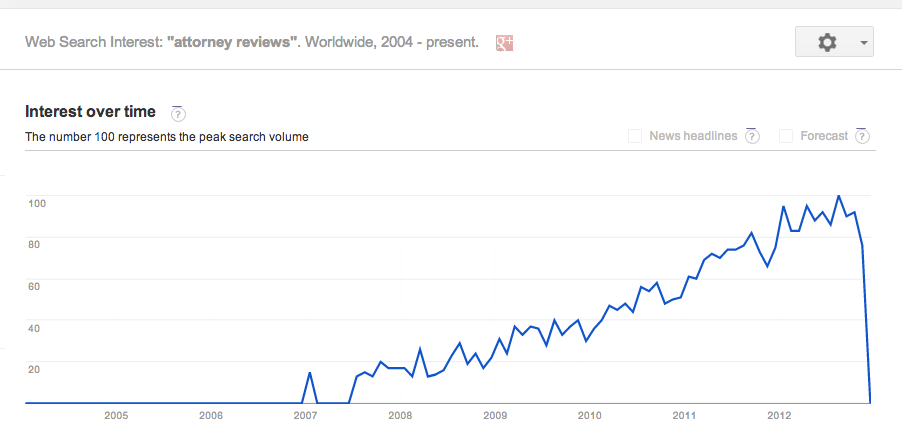


Public demand for lawyer ratings is on the rise.  As the above graph from Google Trends  shows, searches for the terms “attorney reviews” have increased five-fold in the past five years (the drop off results after October 2012 only because all data hasn’t yet available).

The push for lawyer reviews is hardly surprising.  Today’s consumers routinely check ratings before reserving hotels, buying books or selecting a roadside diner. Even my thirteen year old, who frequently trolls Ebay for collectibles, won’t spend a minute looking at products purveyed by sellers who haven’t been reviewed.

As I’ve been saying  for years, like it or not, lawyers can’t stop this ratings train.

But here’s what’s interesting. At the same time that clients are searching for online reviews, there’s also been a marked rise in paid leads, such as those run by Total Attorneys  or just introduced by Attorney Boost.com.  Essentially, the lead sellers build up large SEO-visible properties online to attract interested clients, and then sell those leads to attorneys who’ve registered for a particular practice area or region.  Though the concept sounds like paid referrals,  they pass muster  because the lead sellers aren’t making referrals; they’re simply acting as a pass through, sending through leads to lawyers qualified to handle them.  

What do you do with someone who’s blogged nearly a decade and been nominated for ABA Top 100 Blawg Contest for six years straight without ever coming remotely close to winning the category? Stick her along with nine other guys (and yes, they really all are guys) in the Blawg 100 Hall of Fame.  That’s

Damian is the litigator God would have invented if He’d thought that at all a good idea. Chaz is  the lawyer with the best name.  Owen can tell you how it feels to fall off a cliff- because he’s done it. And don’t forget Kim, the firm’s Style Queen and who possesses both the sense

In the nearly ten years that I’ve been blogging at MyShingle, solo and small firm practice has never really been what you’d call buzz-worthy.  Sure, there was that time when the economy first tanked that suddenly solo was the new soho , or when it seemed as if every blog on the beat – from established giants like Westlaw a big-law tabloid , to Above the Law – was adding a solo sub-category. But at the end of the day, the solo-resurgence was more about selling product or expanding market share to make up for depletions caused by big firm layoffs than generating real excitement about the promise of solo practice.  Not surprisingly, the legal profession’s heady little affair with with solo cooled when folks realized that solos are tough customers when it comes to sales — for various reasons ranging from fierce independence to lack of resources to just plain cheapness.

These days, within the legal profession and out, the latest flavor of the month is legal start up.  Some of these new upstarts – like cloud practice management providers or cost effective legal research like Fast Case offer quality products, sensibly priced that enable solos and small firms to improve the level of service that we provide to clients.  Other products (legal auctions, pay per click schemes) are pure garbage that force lawyers to cut their rates or give service away for free in the name of expanding access to law while the company founders take millions in VC funding to the bank.  Yet even normally staid academics and law schools are all jazzed up about technology and the law, with unconferences  designed to reinvent legal practice.

After I shared this quick video clip from the Avvo Conference on my Facebook page, a high school acquaintance remarked:

Sounds like you’re a lawyer that needs to market, what stress!

Though intended sympathetically, the comment stung. Because yes, after almost 25 years of practicing law, 18 as a solo I suppose that I do still have to market myself at a time when I imagined that my career would be on auto-pilot.

That’s not to say that I’m not busy or that I spend the bulk of my week at networking events and conferences or emailing contacts on Linked-In who might send business my way.  But the truth is that if I don’t get myself out in public or touch base with colleagues or introduce myself to folks at bar events or CLEs instead of sitting quietly in the corner that a large portion of my work would dry up. Sure, I get referrals, sometimes from people who’ve never even met me, but it’s not as if a steady stream of paying clients is banging down the door 24/7.  And so, I do what works at least in my industry to keep in people’s faces: newsletters with substantive analysis, an industry- focused blog, presentations or attendance at conferences and industry activities, and serving on a couple of boards.

Sometimes, the marketing isn’t exactly geared at getting clients, but rather, at staying at the forefront on a certain issue. In my industry, reputation matters and there are dozens of lawyers poised to poach on any practice area. So it’s not just enough for me to be out there in the areas where I focus, but to be out there as one of the top authorities on that topic.

At times, I’m proud that I’m not too proud to hustle.  That I eat what I kill and don’t have to rely on others for my next meal.  And that even though I don’t always know when that meal will come or what it will be, I know that I won’t starve.

Much of the work that I do as a lawyer today involves issues that weren’t even around ten years ago. So I was excited to see this recent post from Jordan Furlong on some of the roles that lawyers might play as the more traditional legal positions shrink:  It’s an interesting list:

  • “Amazon.Law” Provider: Sharp, focused, legally trained mind sifting through and analyzing clients’ vast storehouses of data to anticipate legal needs they don’t even realize they have.
  • Civics Trainer: Roving instructor retained to inculcate the rule of law, rights and responsibilities, and other fundamental legal principles to students, employees and citizens.
  • Competitive Analyst: Provider of sophisticated business intelligence operations, infused with deep knowledge of laws and regulations and employing rigorous organizational analytics.
  • Freelance Fact-Checker: Trusted independent authority retained by governments, media and organizations to reliably separate fact from fiction in a truth-challenged society.
  • Judicial Subcontractor: Dispute resolution expert deputized by judges to go out and “bring courts to the community,” increasing access to justice and clearing court backlogs.
  • Mobile Arbiter: Conflict resolution facilitator called in to troubleshoot everyday disputes at homes or in the workplace before they become full-blown fights: “preventive ADR” on a moment’s notice.
  • Social Connector: Using deep networks that range across business, government and private individuals, connecting people, organizations, ideas and initiatives that will complement each other, solve problems, and create opportunities.

While these models are interesting, my initial reaction to some of them is “show me the money.” Who’s going to pay for the civics trainer or the mobile arbiter (an idea that I love, by the way, very much in line with lawyering on the front)? Today’s courts can barely bring themselves to adopt e-filing or video conferencing for short conferences – are they really going to be able to send out subcontractors to the community.  Convenience and justice are, at times, almost oxymorons.