
If you thought that aggressive enforcement of copyright was only for the RIAA, think again. The ABA is just as intent about enforcing copyright interests in its ethics opinions. But whether you agree with the RIAA’s tactics or not, at least its copyright enforcement activity is intended to protect RIAA’s constituents; artists, musicians and
If Forrest Gump Were A Lawyer Blogger
You know the movie, Forrest Gump, where a seemingly dim protagonist accidentally winds up at the forefront of many historic moments, and finds wild success beyond whatever anyone ever expected? Forrest Gump came to mind when I learned about solo personal injury lawyer Eric Turkewitz’s most recent foray into the big time. Of
Run Solo Run: Does Running for Office Jumpstart or Stop A Legal Career?
With Election Day less than a month away and the public tiring of hearing about Obama or Romney, the media has turned its attention to local and lesser known candidates. Moreover, many of those capturing the spotlight are either solos or younger lawyers just starting their careers.
For example, up in Maine shingler Cynthia Dill,
Is Price Transparency Always A Good Thing for Prospective Clients?
As Matt Homann points out, price transparency is coming soon already here in both the medical and legal profession. Of course, it goes without saying that most lawyers dislike the idea of putting price on their website either for fear that competitors will undercut them or concern that clients will be deterred by a high hourly rate. But more importantly, is price transparency a good thing for clients? I don’t think so.
There are plenty of objections to posting price on a website. One commenter at Matt’s site asserts that price listings commoditize legal services, while I’ve previously observed that rates, without context don’t give any sense of how much a case will cost. But what’s worst about price transparency is that it deprives lawyers of pricing flexibility, largely to the detriment of consumer clients.
The dirty little secret of law practice is that most lawyers have multiple rates. In my industry, most lawyers have different rates for municipal and corporate clients or large established developers and nascent renewable start-ups. Likewise, in consumer industry, many lawyers charge an established businessman more for a contract or criminal defense representation than a more impoverished client.
While different rates for different clients seems unfair, it’s not for several reasons. Often, a well-heeled client has more complex needs (a gazillionaire who wants to avoid tax on his passing will need more complicated estate planning than a civil servant) or a stronger interest in the outcome of the case (a prominent local politician could endure more harm to his reputation if convicted of a DUI than an unemployed octogenarian). Moreover, ethics rules don’t require identical rates for seemingly identical work but only that overall rates for a matter are reasonable.
Solo Off to A Bad Start
Starting a law practice is hard enough, without having to defend yourself in a lawsuit. But that’s the position that Carolyn Hartle finds herself in, according to the Sharon Herald, after having launched her new practice while she was still working as an associate at her former law firm, Lewis and Ristvey. But is this a case of an associate who prematurely – and unethically – jumped the gun, or a disgruntled law firm desperate to protect its turf?
For now, I’m limited to the the reported facts. First, the article says that Hartle incorporated her new practice on July 30 and leased space around that time, but did not disclose her intent to start a competing firm. At this juncture, Hartle did nothing wrong. Undertaking tasks preparatory to opening another firm on your own time while still employed doesn’t run afoul of any ethics rules. And even assuming that the firm asked Hartle directly if she planned to start a firm, she wasn’t necessarily dishonest in denying her intentions since preparations aside, she may still not have been fully certain. Indeed, she wouldn’t be the first prospective solo to get cold feet and pull out.
Subsequently, on August 31 while still employed at the firm, Hartle sent a letter on her new firm’s stationary to all of the firm’s clients informing them that she was starting a firm to open on September 17 and giving them an opportunity to transfer their files. According to the article, several hundred clients executed letters to transfer their representation.
Will Ability Will Prevail?
If you have the time, take a few minutes to scroll through How Technology Is Rewiring the Practice of Law, a to-the-point and not to be missed presentation by Bob Ambrogi, my friend and former Legal Blog Watch co-blogger. In addition to interesting statistics about the current state of the legal profession’s use of
Social Media v. Referrals: No long an either/or proposition
If you’re a regular reader of this blog, you’re familiar with the perennial debate over whether social media or personal referrals are the best way to grow a business. Those who hail from the referral-based school of marketing contend that social media is a waste of time, attracting tire-kickers and dud clients. Meanwhile, those who endorse social media as the be all and end all of marketing deride those who don’t unquestioningly jump on the bandwagon as hopelessly out of touch.
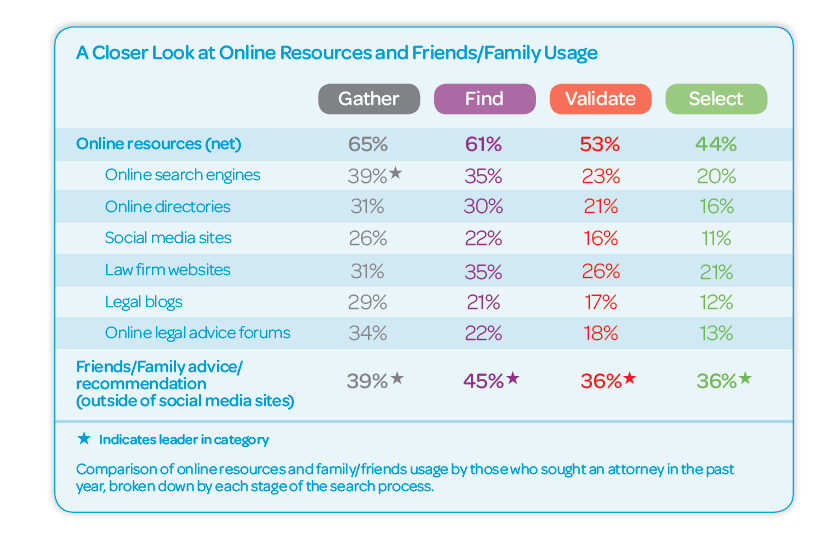
As for me, I’ve never understood why social media versus referral marketing was ever an either/or. And a recent study by LEXIS bears out that consumers are using both personal references and and social media in hiring a lawyer. As the attached chart shows, personal references are still the dominant source over any single type of Internet or social media platform. But social media, blogging and websites collectively hold greater influence over consumer hiring decisions than referrals.
The Way of Life
In just a few hours, my sweet Mira will step to the front of the synagogue on the occasion of her bat mitzvah. Before family and friends, she will chant the parshat (Torah portion) where Moses speaks to the Jewish people for the last time before they cross the Jordan into Canaan. But Moses cannot
A Bit of A Break & Crowdsourcing Request
Just a quick note to let you know that I’m taking a brief break. Between an out of town hearing last week, Jewish holidays, my younger daughter’s upcoming bat-mitzvah this weekend, a touch of writing block and most critically, a terrible cold, I just can’t muster the energy to post. I’ll be back up and
Social Media and Lawyers’ Duty To Report
By now, you may have heard via Simple Justice or Legal Ethics Forum about the news accounts of the public defender who lost her job after posting a photo of her client’s leopard-print briefs on her Facebook page along with a caption suggesting that the underwear was the client’s family’s idea of proper court attire. Although the photo appeared on the PD’s private Facebook page viewable only by her FB friends, someone saw the photo and turned it over to the judge who declared a mistrial.
While lawyers have long been cognizant of the ethical dangers of social media, most of the first generation of gaffes resulted from open and obvious conduct – like tweeting a confidential settlement award or lying to or insulting a judge on a public blog or Facebook page. What sets this case apart is that the PD apparently took care to protect her posts to ensure that her remarks didn’t go beyond her inner circle.
Of course, one lesson here is that lawyers should never confuse social media or the Internet with Las Vegas since what happens online is never guaranteed to remain there. Whether it’s a 140-character tweet to a select handful of followers or a lengthy missive to a listserve, any viewer or recipient disseminate the information via a forward button or preserve it via screenshot. But by now, that digital communications leave a permanent impression ought to be obvious to most lawyers.
What interests me more about this story (and surprisingly, it’s a topic that I’ve not seen widely discussed) is the extent to which we lawyers have an obligation to address or report unethical conduct that we come across on private listserves or social media platforms. For example, did the PD’s lawyer friends who viewed her post (as well as other commentary expressing an opinion that her client was guilty) have an ethical obligation to report her to the judge – or at least confront her about the impropriety of her postings? If an attorney on a listserve discloses that he represents two co-defendants in a criminal matter where the only defense is to point the finger at each other, should other lawyers call the lawyer out on an un-waivable conflict – or go further and report the lawyer to the grievance committee or out them on blog?